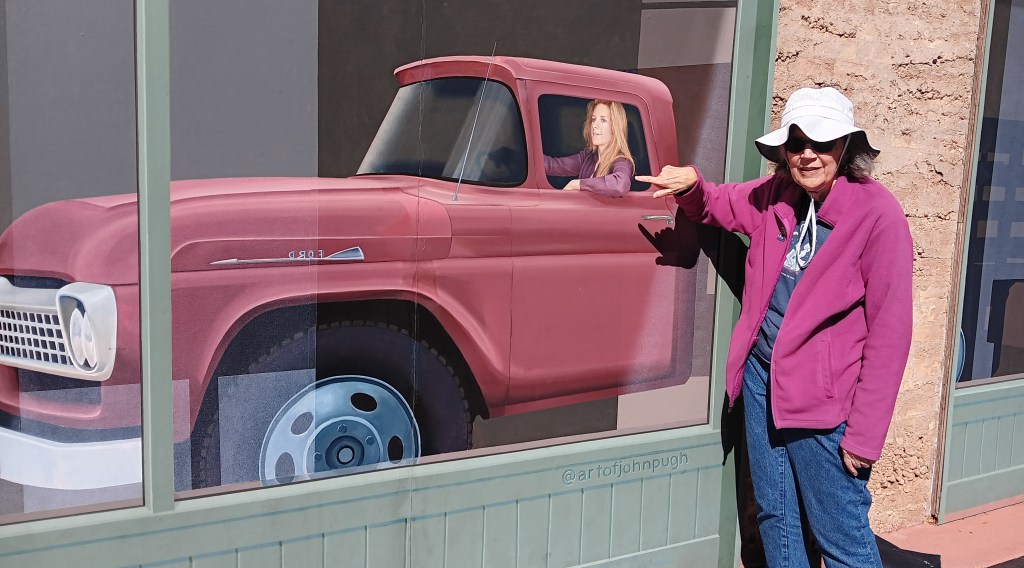
There is a girl in a flatbed Ford on a corner in Winslow, Arizona. She’s a mural on the wall. Next to the curb is an actual red flatbed Ford (but no actual girl.) Add in a statue of Glenn Frey, a few plaques, tourists waiting in line for their photo opps, and shops on more than one corner that sell Eagles memorabilia of all kinds. This is the Winslow experience.
But there’s more and if you only get to the that corner, you’re missing it. The beautifully restored Harvey House hotel, La Posada, is a few blocks away down the railroad track. Designed by Harvey’s favorite architect Mary Colter, in its heyday La Posada welcomed in hungry and tired travelers on the rail route between Chicago and Los Angeles. Winslow was a base for early travelers who booked Detours into “Indian Country” a century ago. The beautiful hotel fell into disrepair later in the twentieth century when people stopped travelling on trains. A California couple, architect Allan Affeldt and artist Tina Mion, found the resources to restore it, and today it is a lovely place to stay, eat in an award-winning dining room, wander the restored gardens, and sit and watch trains. The hotel lives in a different century than the corner the Eagles sang about.
Somewhere in between those places that seem to exist so far away from each other in time is the town of Winslow where people live. There are homes, churches, a Wells Fargo bank, and more downtown buildings that are now called vintage. They are on the old Route 66, bypassed by Interstate 40 during the mid-twentieth century that left Main Street with closed store fronts. There is also the Winslow that grew up to meet the Interstate traffic. It has the kinds of business you expect to find near interstate exits–chain hotels and restaurants, removed from the Main Street of the town by a few miles.
Outside of the odd juxtaposition of a one hundred year old classic hotel and a tourist mecca brought on by an Eagles hit, Winslow looks like a lot of western towns that seem to have lost their center point. It may look like most of its corners have been forgotten. But they are there. We have only to look for them.

