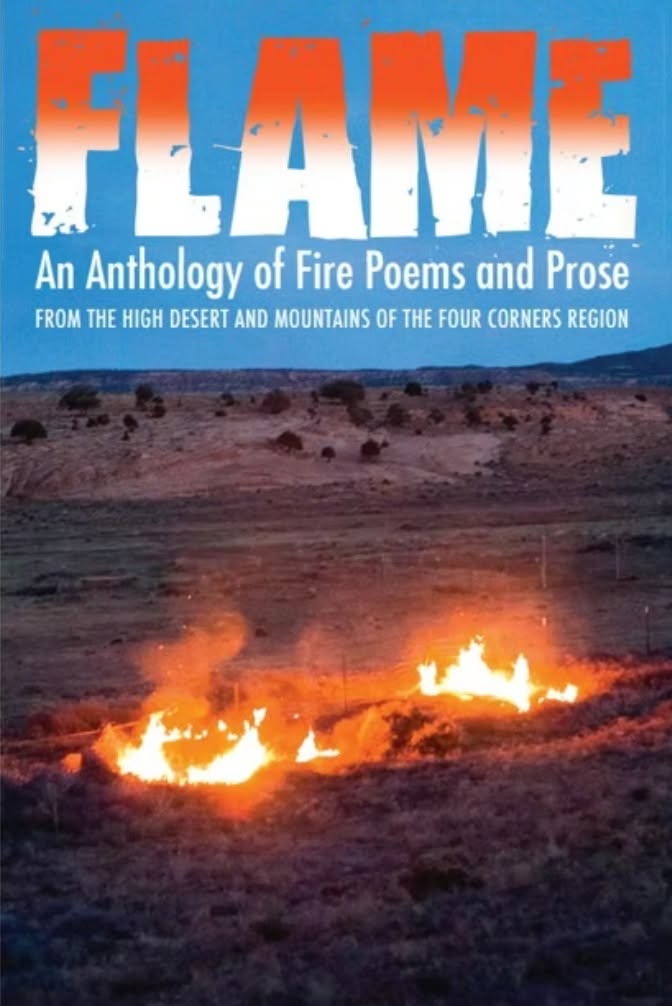
Playing With Fire

I am honored to have a piece in this beautiful new anthology. My friend and long-time colleague Michael Thompson, one of the editors of this book, emailed me last spring and asked me to take up the challenge. What could I come up with to fit the theme of fire? I loved this challenge and I work well with deadlines, so I took it on and they ultimately accepted my submission.

My contribution starts, “Fire cleanses. The forest needs it to survive. It will pull in the lightning and set itself ablaze. Out with the dead wood, making the way for new life. What does it have to teach us?” My question took me through the next 4 pages of pondering it.

A friend asked me what genre my piece is and I had to pause. Creative non-fiction, I guess, but there is also an embedded poem. Multi-genre may be the best answer. In any case, it’s exciting to have produced something that fits into a collection of “Fire Poems and Prose.” It sent me to dreaming of ancient bonfires.

Flame is the third book in a series that celebrates our elemental connections to our planet. First came Wet, honoring the element of water. Next was Fertile with earth poems and prose. Now Flame. You can expect that Breath isn’t too far away in the future.

Sacred Elements Press is led by aforementioned Michael Thompson of Farmington, New Mexico, who with co-editor Renee Podunovich took up the leadership of this project when Cortez artist Sonja Horoshko, the woman who birthed the first two anthologies, passed away before anyone was ready to let her go.

The books are available at Maria’s Bookstore in Durango, Colorado, the Lithic Bookstore in Fruita, Colorado, and the Quill & Qwest Bookstore and the Farmington Museum in Farmington, New Mexico. You can also order online at the Sacred Elements website. I think if you order one, you won’t regret it.
Standing on Corners

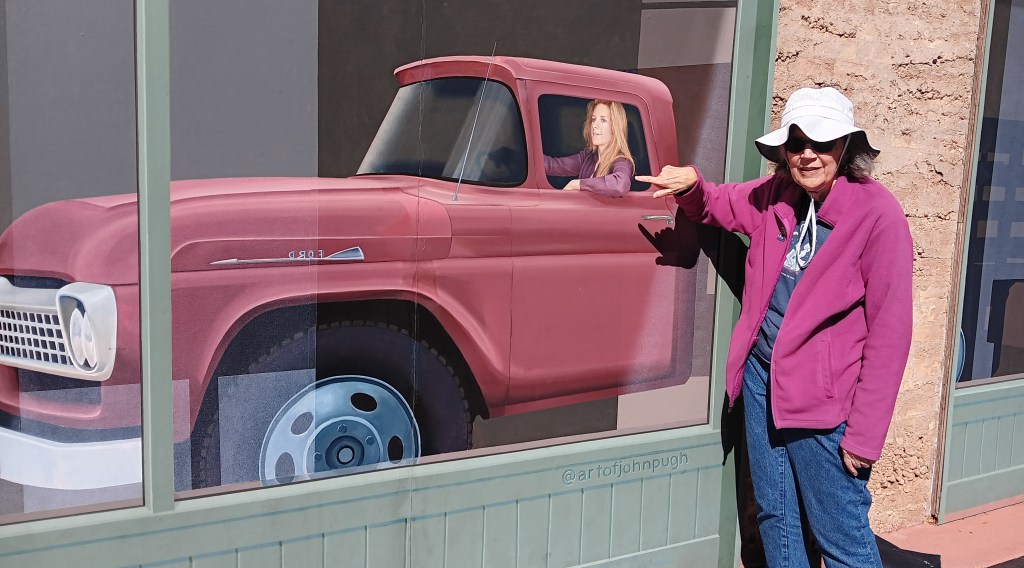
There is a girl in a flatbed Ford on a corner in Winslow, Arizona. She’s a mural on the wall. Next to the curb is an actual red flatbed Ford (but no actual girl.) Add in a statue of Glenn Frey, a few plaques, tourists waiting in line for their photo opps, and shops on more than one corner that sell Eagles memorabilia of all kinds. This is the Winslow experience.

But there’s more and if you only get to the that corner, you’re missing it. The beautifully restored Harvey House hotel, La Posada, is a few blocks away down the railroad track. Designed by Harvey’s favorite architect Mary Colter, in its heyday La Posada welcomed in hungry and tired travelers on the rail route between Chicago and Los Angeles. Winslow was a base for early travelers who booked Detours into “Indian Country” a century ago. The beautiful hotel fell into disrepair later in the twentieth century when people stopped travelling on trains. A California couple, architect Allan Affeldt and artist Tina Mion, found the resources to restore it, and today it is a lovely place to stay, eat in an award-winning dining room, wander the restored gardens, and sit and watch trains. The hotel lives in a different century than the corner the Eagles sang about.

Somewhere in between those places that seem to exist so far away from each other in time is the town of Winslow where people live. There are homes, churches, a Wells Fargo bank, and more downtown buildings that are now called vintage. They are on the old Route 66, bypassed by Interstate 40 during the mid-twentieth century that left Main Street with closed store fronts. There is also the Winslow that grew up to meet the Interstate traffic. It has the kinds of business you expect to find near interstate exits–chain hotels and restaurants, removed from the Main Street of the town by a few miles.

Outside of the odd juxtaposition of a one hundred year old classic hotel and a tourist mecca brought on by an Eagles hit, Winslow looks like a lot of western towns that seem to have lost their center point. It may look like most of its corners have been forgotten. But they are there. We have only to look for them.

My Sister’s Colors

My beloved sister Phyllis made her final exit from the planet this past April. She had a complicated very early childhood, and her teenage years can best be described as tumultuous. Mother called her lively. Dad chuckled and called her “a pistol.” Phyllis was fierce about those she loved, and she was opinionated, often beyond what I considered reasonable.  But through it all, she never lost her sense of humor and her joy. I was so lucky to have her as my big sister and without her now my life seems a little emptier.  Godspeed, Big Sister.  I wrote this for her a few years ago. In her honor, please go out and do something PURPLE. And come back and tell us about it.

My Sister’s Colors–for Phyllis

My sister rescued me from the

               safe browns and comfortable blues

“Get away from there!”  she said,

               pulling me into the racks of purples and reds.

“Mother is not here—dive into the FUSCHIA!”

My sister lives on the brighter side of the color wheel,

               blazing a trail, leaving hot pink footprints.

Paint yourself in the brights.

Dare to be orange.

Dance in the lime green.

We don’t have to blend into the background scenery

               the robin browns and the pale egg blues

               of our protected childhood.


Claim your colors.